Ethnicity Definition: What It Means, Examples, and Related Terms
A clear explanation of ethnicity, the cultural and historical ideas behind it, and the difference between ethnicity, race, nationality, and ancestry.


In this guide
People often search for an ethnicity definition when a form asks for ethnicity, when family history feels complicated, or when a photo-based tool seems to suggest a background. The short answer is that ethnicity describes belonging connected to culture and shared history, not a label that can be proven from a face alone.
Ethnicity is best understood as a layered social identity. Language, family stories, traditions, religion, food, music, regional origin, migration, and community relationships may all matter. No checklist is required, and no single feature automatically makes someone part of an ethnic group.
This guide separates ethnicity from nearby terms so you can read forms, ancestry results, and AI tools more carefully. It also explains why a person may use several ethnic identities or choose a more specific community name than a form provides.
Ethnicity definition at a glance
A useful working definition is: ethnicity is a shared cultural and historical identity that connects people through heritage, practices, stories, language, or community. The connection may be inherited, lived, chosen, rediscovered, or described differently by different members of the same group.
Ethnicity is therefore broader than ancestry but narrower than a vague idea of being from somewhere. A person can have ancestry linked to a region without actively identifying with every culture associated with it.
| Term | Main question | Typical evidence | What it cannot prove |
|---|---|---|---|
| Ethnicity | Which cultural or historical community do I belong to? | Family heritage, language, traditions, community, self-identification | A person’s character or appearance |
| Race | How has a society grouped or perceived people? | Social categories, history, institutional context | A precise genetic identity |
| Nationality | What country or civic relationship is relevant? | Citizenship or formal national connection | A complete cultural background |
| Ancestry | What family descent or geographic lineage can be traced? | Records, relatives, history, genetic evidence | Current cultural belonging by itself |
Key takeaway
Ethnicity is a cultural and historical belonging. It may overlap with ancestry, race, or nationality, but those terms answer different questions.
What can shape ethnicity?
Culture and shared practices
Culture is often the most visible part of an ethnicity in everyday life. A language, religious tradition, holiday, cuisine, music, clothing practice, or family custom can connect people across generations. Still, culture is not a fixed package: families adapt, communities change, and individuals may participate in some traditions more than others.
Shared practices do not have to be identical for an ethnic identity to be meaningful. Someone raised in a diaspora community may speak a different dominant language while still feeling connected through family history, celebrations, stories, or community relationships.
History, place, and migration
Ethnic groups are also shaped by collective histories. A region, migration route, colonial experience, border change, or shared memory can influence how a group describes itself. These histories may cross modern country borders, which is one reason ethnicity and nationality should not be treated as synonyms.
Place matters, but birthplace alone does not define ethnicity. A person born in one country may grow up with a different family heritage, and a community can maintain an ethnic identity across several countries.
Community and self-identification
Ethnicity usually involves some relationship to a community, whether that community is local, diasporic, regional, tribal, linguistic, religious, or family-based. People may describe the same background at different levels of specificity, such as a broad regional identity, a national-origin community, or a particular Indigenous or cultural group.
Self-identification is important because an outside observer cannot see all of a person’s language, family, relationships, and lived experience. A surname, accent, skin tone, or photograph can never justify assigning an ethnicity to someone else.
Ethnicity examples without turning identity into a checklist
Examples clarify the term, but they should not be used to guess another person’s background. The same person may use a broad and a specific label depending on the situation, and a mixed family may include several ethnic histories.
For example, Korean, Yoruba, Punjabi, Māori, Jewish, Kurdish, Mexican, Afro-Brazilian, and Sámi can be used as ethnic or cultural identities in particular contexts. The meaning depends on the community, country, history, and the way the person uses the term.
| Situation | Possible description | Why context matters |
|---|---|---|
| A family with several backgrounds | Two or more ethnic heritages | People may choose one, several, or a more specific community label |
| A diaspora household | A cultural identity maintained across countries | Language and traditions may change while community ties remain |
| A form with broad categories | The closest self-described ethnicity plus a write-in | Institutional labels rarely capture every community |
| A person with uncertain family records | A tentative family-history description | Uncertainty should be stated rather than replaced by a guess from appearance |
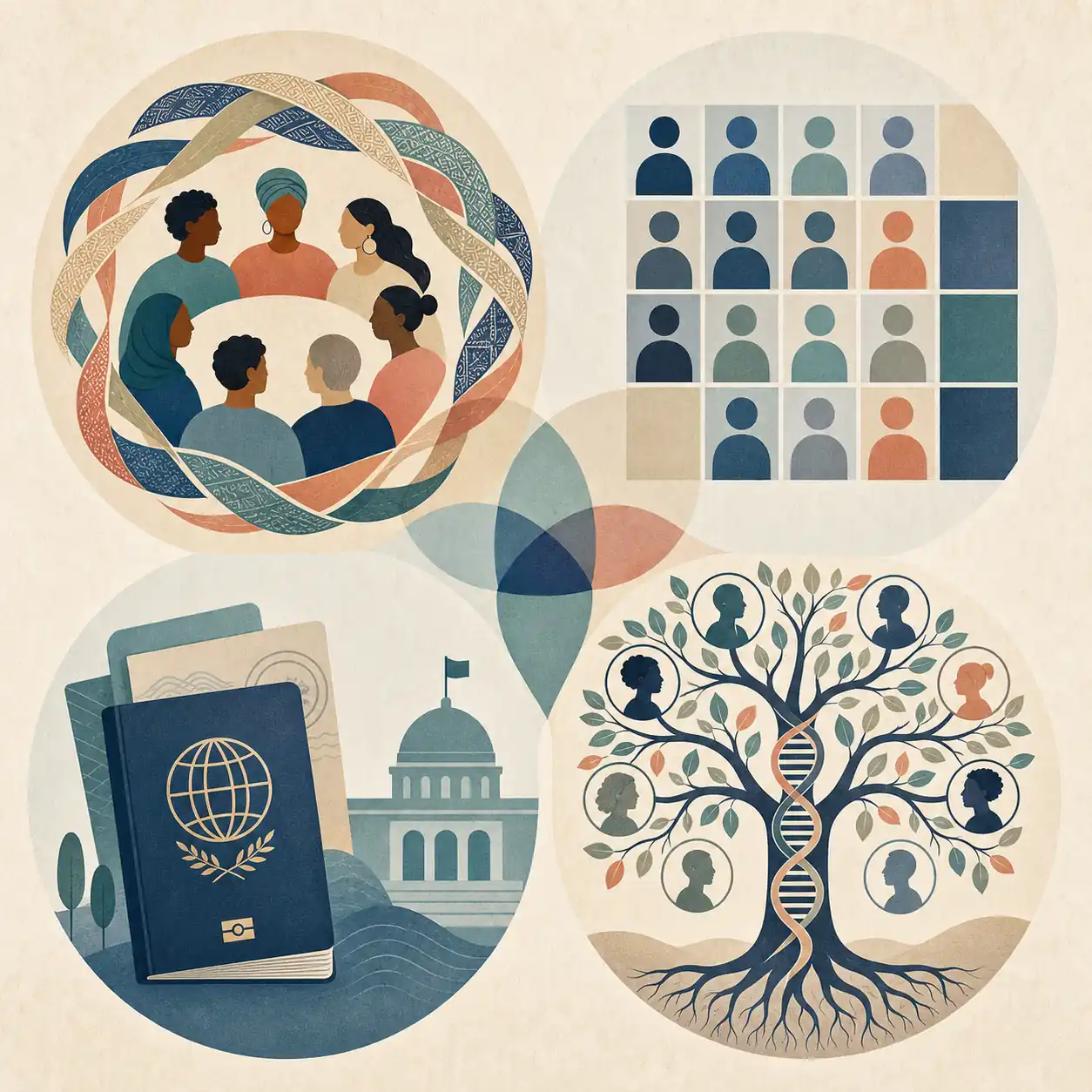
Ethnicity vs race, nationality, and ancestry
Race generally refers to broad social categories created and used by societies, often in connection with perceived physical traits and historical power. Race can have real consequences through discrimination and institutions even though it is not a precise biological map of every person.
Nationality usually refers to citizenship or a formal connection to a country. One nationality can include many ethnicities, and one ethnic community can live across several countries. Ancestry refers to family descent or geographic lineage; it can inform ethnicity but does not automatically determine a person’s present-day cultural belonging.
Keeping the terms separate makes questions clearer. Ask about citizenship when nationality is relevant, family descent when ancestry is relevant, and cultural or community belonging when ethnicity is relevant.
- Birthplace is a life event, not an ethnicity.
- A DNA estimate is evidence about selected genetic comparisons, not a final identity label.
- A person can have more than one ethnicity, nationality, or ancestry line.
- Appearance is not reliable evidence of language, culture, or community membership.
- Check whether the form asks about ethnicity, race, ancestry, nationality, birthplace, or citizenship.
- Read the form’s own definitions instead of assuming every institution uses the same categories.
- Choose more than one option when the form allows it and the answer reflects your identity.
- Use a write-in field for a specific community when broad labels are incomplete.
- Do not guess another person’s ethnicity from a photo, name, accent, or location.
- Ask how someone identifies instead of guessing.
- Separate ethnicity from race, nationality, ancestry, religion, and birthplace.
- Allow more than one identity when the context permits it.
- Use community-preferred names and explain broad categories on forms.
- Treat identity data as sensitive personal information.
- U.S. Census Bureau: Race and Ethnicity — Background on how a major public data system describes and measures race and ethnicity.
- OMB Statistical Policy Directive No. 15 — The official 2024 U.S. federal standards for collecting and presenting race and ethnicity data.
- National Human Genome Research Institute — A clear explanation of genetics and genomics that helps distinguish genetic evidence from social identity labels.
- Race vs ethnicity — Compare the two terms with examples and form guidance.
- Nationality vs ethnicity — Separate citizenship from cultural and historical belonging.
- Ethnicity estimate guide — Learn what DNA ethnicity percentages can and cannot tell you.
- What ethnicity am I? — Explore family history, culture, community, and responsible next steps.
- Ethnicity examples — See examples without turning identity into a rigid checklist.
How ethnicity appears on forms
Forms use ethnicity inconsistently. A census, hospital intake form, school application, research survey, or workplace form may define categories differently and may combine ethnicity with race or national origin. Read the instructions before choosing an answer.
If multiple selections or a write-in field are available, use them when they describe you more accurately. If you are completing a form for another adult, ask them rather than inferring from appearance, surname, or birthplace. For children, families may record more than one background.
When a required category feels too broad, choose the closest accurate option only when necessary and use an explanation field or contact the organization if the information affects care, eligibility, or legal records.
Why ethnicity definitions vary by country and institution
Ethnicity is not recorded in one universal way. Government agencies, researchers, schools, employers, and health systems may use different categories because they have different goals. Some need broad statistics; others need detailed community information or a person’s own description.
In the United States, the Office of Management and Budget revised federal race and ethnicity standards in 2024, including a combined question format and a Middle Eastern or North African reporting category. Agencies still implement standards through their own programs, so forms will not all change at the same time.
A standard is a data-collection tool, not a complete theory of identity. When a form’s wording is unclear, use its instructions, ask the organization how the data will be used, and remember that a broad category may be administrative rather than personally descriptive.
Ethnicity, ancestry, DNA estimates, and AI tools
Ancestry is about family descent and the geographic or historical lines that can be traced through relatives, records, oral history, or genetic evidence. Ethnicity may grow from ancestry, but it also includes culture, community, and self-identification. A person can have ancestry from a region without actively belonging to every culture associated with it.
Consumer DNA ethnicity estimates compare selected genetic markers with reference panels. The percentages are statistical estimates, and they may change when a company updates its reference data or model. They do not prove citizenship, tribal citizenship, cultural membership, or a person’s race.
AI photo tools answer a different and narrower question: what visible patterns might a model associate with a broad group? Lighting, angle, expression, styling, training data, and model limitations can affect the output. Such tools may be interesting for exploration, but they cannot define ethnicity.
Important limitation
Use family history, community knowledge, records, and DNA evidence for different kinds of questions. Never use an AI guess or DNA percentage for medical, legal, employment, immigration, eligibility, or identity decisions.
How to use the term ethnicity respectfully
Use the most specific term that is relevant and that the person or community accepts. Do not bring up ethnicity when it has no bearing on the subject. If you are collecting data, explain why you need it, allow self-identification, minimize mandatory fields, and protect the information from unnecessary exposure.
Be careful with examples and group comparisons. An ethnic label can describe history and belonging, but it should not be used to predict personality, intelligence, behavior, health, or ability. Ask rather than assume, and let people correct the label.