How to Know Your Ethnicity: A Practical 7-Step Guide
Use records, DNA, culture, and photo-based clues in the right order so your answer is evidence-based, not a guess.

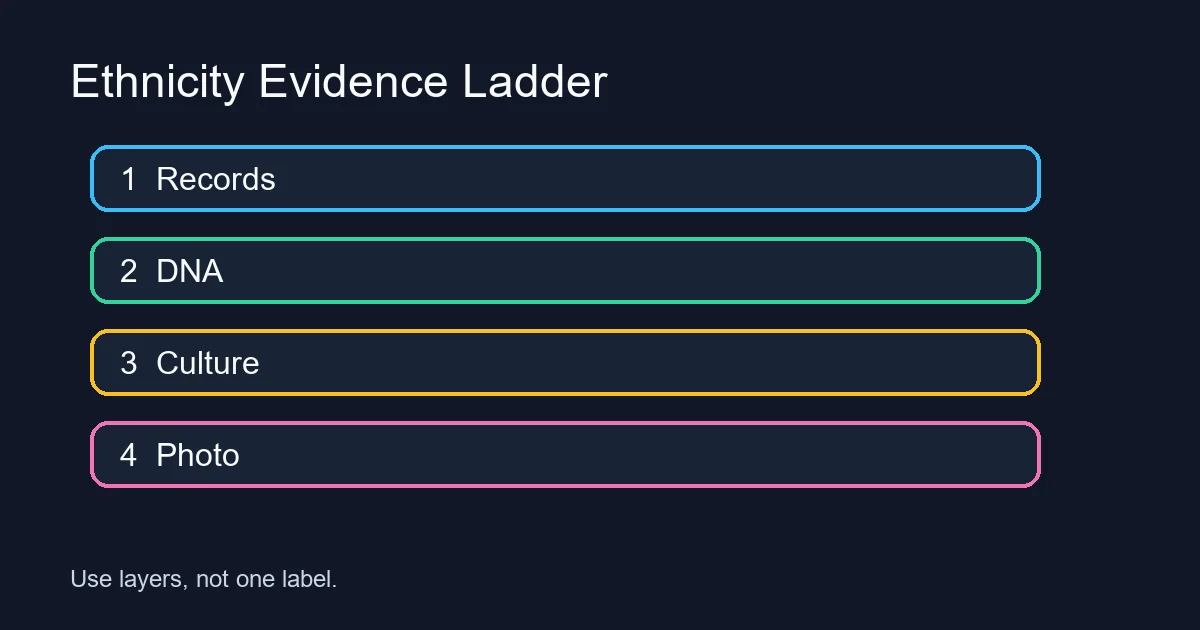
Table of Contents
- Quick Answer: Build an Evidence Stack, Not a Single Label
- The Ethnicity Evidence Map
- 7 Steps to Work Out Your Ethnicity
- Start With Records Because They Give Names, Dates, and Places
- How to Read DNA Results Without Overclaiming
- Where AI Photo Tools Fit in the Process
- Common Mistakes to Avoid
- Frequently Asked Questions
If you have searched for how to work out what exactly your ethnicity is, you are probably looking for more than a quick label. You may have family stories that do not line up, a DNA result with confusing percentages, or a photo tool that gave an interesting but incomplete answer. The useful path is to separate four questions: what your family records show, what your DNA suggests, what culture you were raised in, and what you appear to look like in a photo.
Quick Answer: Build an Evidence Stack, Not a Single Label
To know your ethnicity, start with family history and records, then compare that evidence with DNA ancestry results, cultural self-identification, and, only as a light appearance clue, AI photo analysis.
Ethnicity is partly about shared ancestry, but it is also about culture, language, traditions, migration, and community belonging. A DNA percentage can support your research, but it cannot tell the whole identity story.
Key Takeaway
The best answer is layered: records plus DNA plus cultural context. Photo tools are useful for curiosity about appearance, not proof of ancestry.
The Ethnicity Evidence Map
Before you spend money or trust a result, decide which kind of evidence fits your question. The table below keeps the boundaries clear.
| Evidence source | Best for | What it cannot prove |
|---|---|---|
| Family records | Names, places, migration routes, relatives, and historical context | Deep ancestry beyond available documents |
| DNA ancestry test | Inherited population clues and potential relative matches | Culture, nationality, language, or exact ethnic identity |
| Cultural background | How you were raised, community ties, traditions, and self-identification | A genetic percentage or legal status |
| AI photo analysis | What your facial features may resemble in one image | DNA ancestry, ethnicity membership, or family history |
7 Steps to Work Out Your Ethnicity
Follow the steps in this order so each clue checks the last one instead of replacing it.
1. Write down what you already know
Create a simple list of parents, grandparents, known birthplaces, languages, surnames, religions, and family migration stories. Mark each item as confirmed, remembered, or uncertain.
This prevents family lore from being treated as proven fact too early.
2. Interview relatives with specific prompts
Ask older relatives about maiden names, villages, documents, nicknames, holidays, recipes, and why the family moved.
Small details often point to a region more reliably than broad labels.
3. Collect records before interpreting identity
Look for birth certificates, census records, immigration documents, church or civil records, obituaries, and old addresses.
Documents give names and places that DNA percentages alone cannot supply.
4. Separate ethnicity from nationality and race
Nationality is legal or civic, race is usually a broad social category, and ethnicity is closer to shared culture, ancestry, language, and history.
Mixing these terms is the fastest way to get a confident but wrong answer.
5. Use DNA as a comparison layer
If you take a DNA test, compare the largest regions and communities with your family timeline. Treat small percentages carefully.
A DNA estimate is a model based on reference panels, not a final identity certificate.
6. Check cultural connection honestly
Ask which languages, customs, religious traditions, foods, names, stories, or communities shaped your life.
Someone may have genetic ancestry from a place without being culturally raised in that group.
7. Use AI photo tools only for appearance-level curiosity
A photo tool can answer what ethnicity you may look like in one image. It cannot verify ancestry, family records, or cultural identity.
Use it as a fun starting point, then return to records and DNA for stronger evidence.
Start With Records Because They Give Names, Dates, and Places
Family records are less glamorous than a DNA dashboard, but they are often more useful for answering exactly who your people were and where they lived.
When a story is vague, turn it into a research question. Instead of writing maybe Balkan, write a checkable sentence about a named relative, place, and date range.
- Civil records Birth, marriage, and death certificates can reveal surnames, birthplaces, parents, and religious affiliations.
- Immigration records Passenger lists, naturalization papers, and border records can show migration routes and previous residences.
- Community records Religious, school, military, cemetery, and local newspaper records often preserve ethnic identity more clearly than national documents.
- Family artifacts Photos, letters, recipes, clothing, and inscriptions can preserve language and cultural clues that official records omit.
How to Read DNA Results Without Overclaiming
A DNA ethnicity estimate compares your genetic markers with reference populations. It can help with broad regional clues and finding relatives, but it is still an estimate.
Use the biggest, repeated signals first. If several providers and family records point to the same broad region, that is stronger than a tiny single-provider percentage.
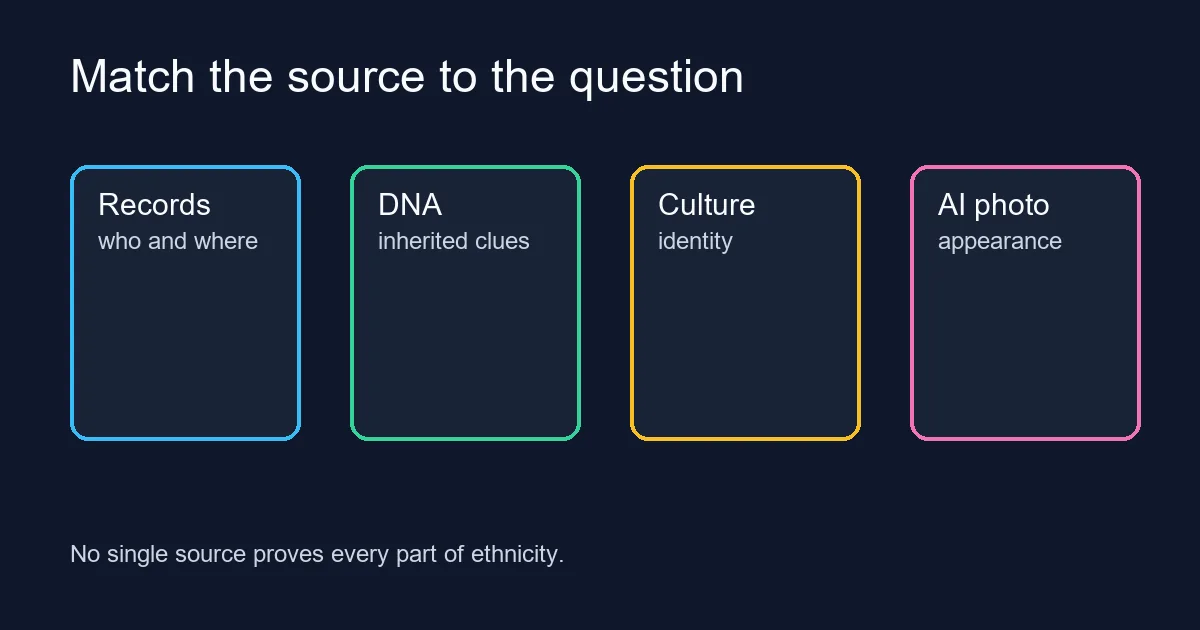
Use each source for the question it can answer: records for people and places, DNA for inherited clues, culture for identity, and AI photos for appearance only.
Where AI Photo Tools Fit in the Process
AI photo tools analyze visible facial patterns in a specific image. Lighting, angle, expression, age, and image quality can change the result.
Use a photo tool as a curiosity layer. If the result suggests a direction you did not expect, write it down as a question and compare it with records or DNA.
Common Mistakes to Avoid
Most confusion comes from expecting one tool to answer every identity question.
- Do not treat nationality as ethnicity. A passport or birthplace does not automatically describe ethnic background.
- Do not overread tiny DNA percentages. Small percentages may shift when the provider updates its reference panel.
- Do not let a photo result override family evidence. Appearance can overlap across many populations and cannot prove ancestry.
- Do not ignore culture. Ethnicity can include language, tradition, religion, community, and self-identification.
- Do not force a single label. Many people have mixed, layered, or changing ethnic identities.
Frequently Asked Questions
A Better Answer Comes From Layers
Your ethnicity is not a single number, app output, or checkbox. It is a layered answer built from ancestry, family history, culture, community, and personal identification.
Use records to anchor your family story, DNA to add inherited clues, culture to understand lived identity, and AI photo tools only for appearance-level exploration.
References
- National Human Genome Research Institute: overview of genetic ancestry and human variation. View Source
- U.S. Census Bureau: race and ethnicity concepts in official data collection. View Source
- Encyclopaedia Britannica: ethnicity definition and cultural identity context. View Source
About the Author
Sophie Laurent
Sophie Laurent writes about identity, ancestry, family history, and the practical limits of AI and DNA tools. Her work helps readers separate curiosity, evidence, and overclaiming when they explore where they come from.
Last updated: Updated June 18, 2026