Race Checker: How to Use AI Photo Results Without Overreading Them
A practical guide to what a race checker can estimate, what it cannot prove, and how to separate appearance, ethnicity, ancestry, and form categories.

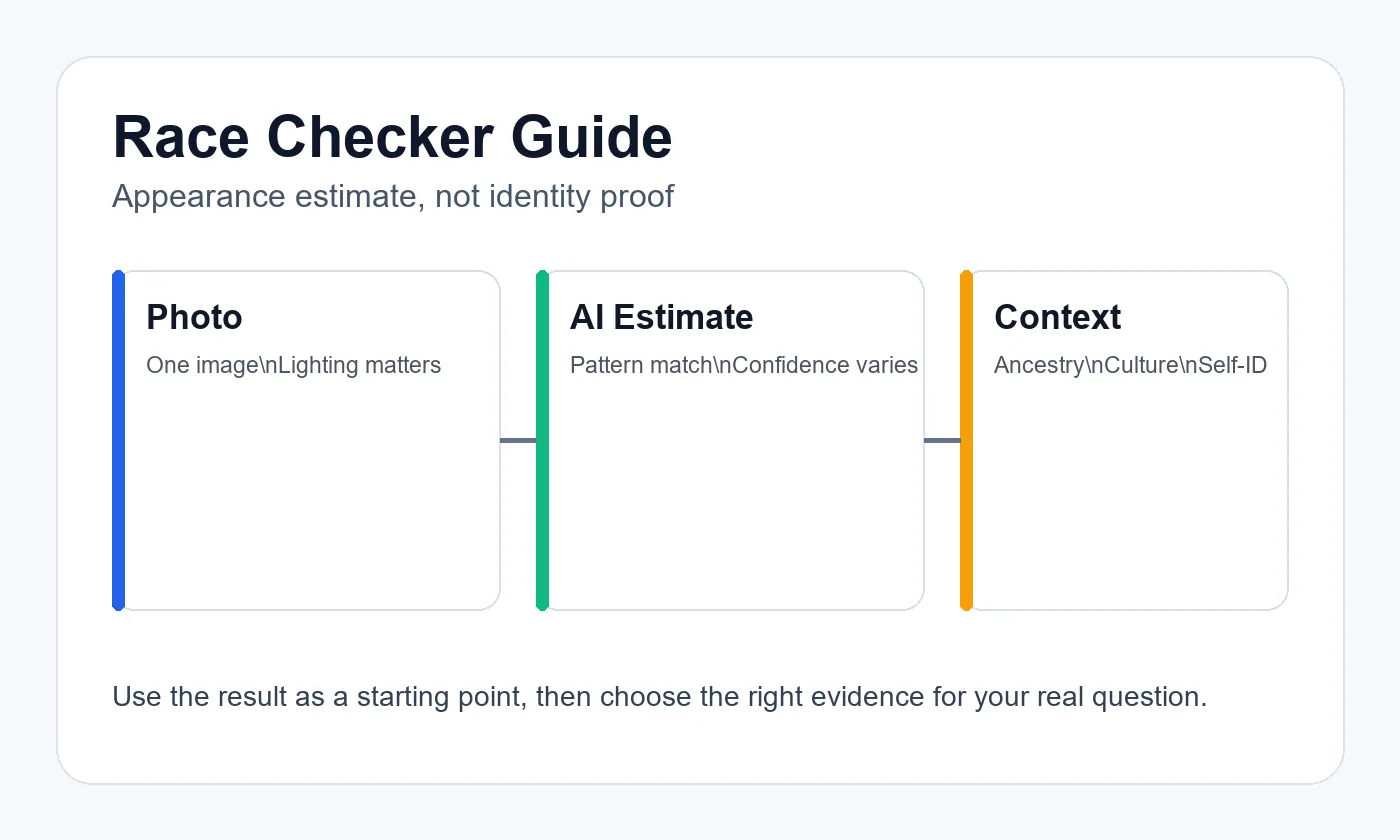
Table of Contents
People search for race checker when they want a quick answer from a photo: what race do I look like, why do people guess my background differently, or whether AI can explain visible facial patterns. The useful answer is more careful than a label. A race checker can estimate how one image may be visually interpreted, but race is also a social category shaped by history, local context, and self-identification.
Quick Answer: A Race Checker Estimates Appearance, Not Identity
A race checker by photo can compare visible image patterns with a trained model and return a likely appearance-based category. That result is not a genetic test, not a cultural biography, and not a final identity label.
Use the result as a lightweight clue only. If you want ancestry, use DNA and family records. If you want ethnicity, consider culture, language, heritage, and family history. If you need to answer a form, follow that form's definitions because race categories differ by country and institution.
Key takeaway
The safest way to read a race checker result is: this is how one photo may be perceived, not proof of who I am.
What People Usually Mean by Race Checker
Most searches for race checker are not academic. They come from everyday confusion: strangers guess different backgrounds, a person has mixed family history, or someone wants to compare how a selfie is read by AI.
That intent is distinct from a broad ethnicity guide. The searcher wants a clear tool-oriented explanation: what the checker is doing, why results can vary, and when a different method is more appropriate.
Race vs Ethnicity vs Ancestry vs Nationality
These four labels often overlap in conversation, but they answer different questions.
| Term | What it usually describes | Example |
|---|---|---|
| Race | Broad social grouping often tied to appearance and historical classification | Black, White, Asian |
| Ethnicity | Cultural background, heritage, language, traditions, or shared history | Irish, Yoruba, Han Chinese, Puerto Rican |
| Ancestry | Family lineage and inherited origins across generations | Southern European and West African ancestry |
| Nationality | Legal citizenship or national belonging | American, Canadian, Brazilian |
How to Figure It Out Without Mixing Up the Question
Use the method that matches the version of the question you actually care about.
If you want an appearance-based answer
Use a photo tool that estimates what race or ethnicity your visible traits resemble. This is best for curiosity about facial appearance, not family proof.
Good fit for: what race do I look like?
If you want an ancestry-based answer
Use DNA testing together with family records, migration history, and conversations with relatives. That gives you a stronger account of inherited background.
Good fit for: where does my family come from?
If you want to answer a form correctly
Read the form instructions and country-specific category definitions. Official race categories are administrative systems, not scientific verdicts.
Good fit for: which race box do I check?
Before You Upload a Photo to a Race Checker
The best race checker result starts with the right input. A model can only read the visible photo, so a low-light selfie or a side-angle crop may answer a different question than you intended.
Use this checklist to decide whether a result deserves attention or whether you should retest with a clearer image.
| Check | Why it matters | Best action |
|---|---|---|
| Clear face | Covered features, sunglasses, heavy filters, and extreme side angles reduce the value of the estimate. | Use a front-facing photo with natural light. |
| One person | Group photos can confuse detection and may mix signals from another face. | Crop to one clearly visible face before testing. |
| Result purpose | Appearance, ancestry, ethnicity, and form categories need different evidence. | Use AI for appearance only; use records or form definitions for other goals. |
| Privacy comfort | Any photo upload should be intentional, especially for identity-adjacent questions. | Avoid uploading images of other people without consent. |
What AI Photo Tools Can and Cannot Do
An AI face analyzer can help with the appearance-level version of the query. It compares visible traits such as face shape, eye area, nose structure, skin tone, and other image-based patterns against a trained model. The output is a perception estimate, not a biological truth statement.
That distinction matters. The same person can get different results from different photos because lighting, angle, age, expression, makeup, and camera quality change the visible input. AI can be useful if you keep the frame honest: it answers what race or ethnicity you look like in a photo, not who you are in the full social, cultural, or genealogical sense.
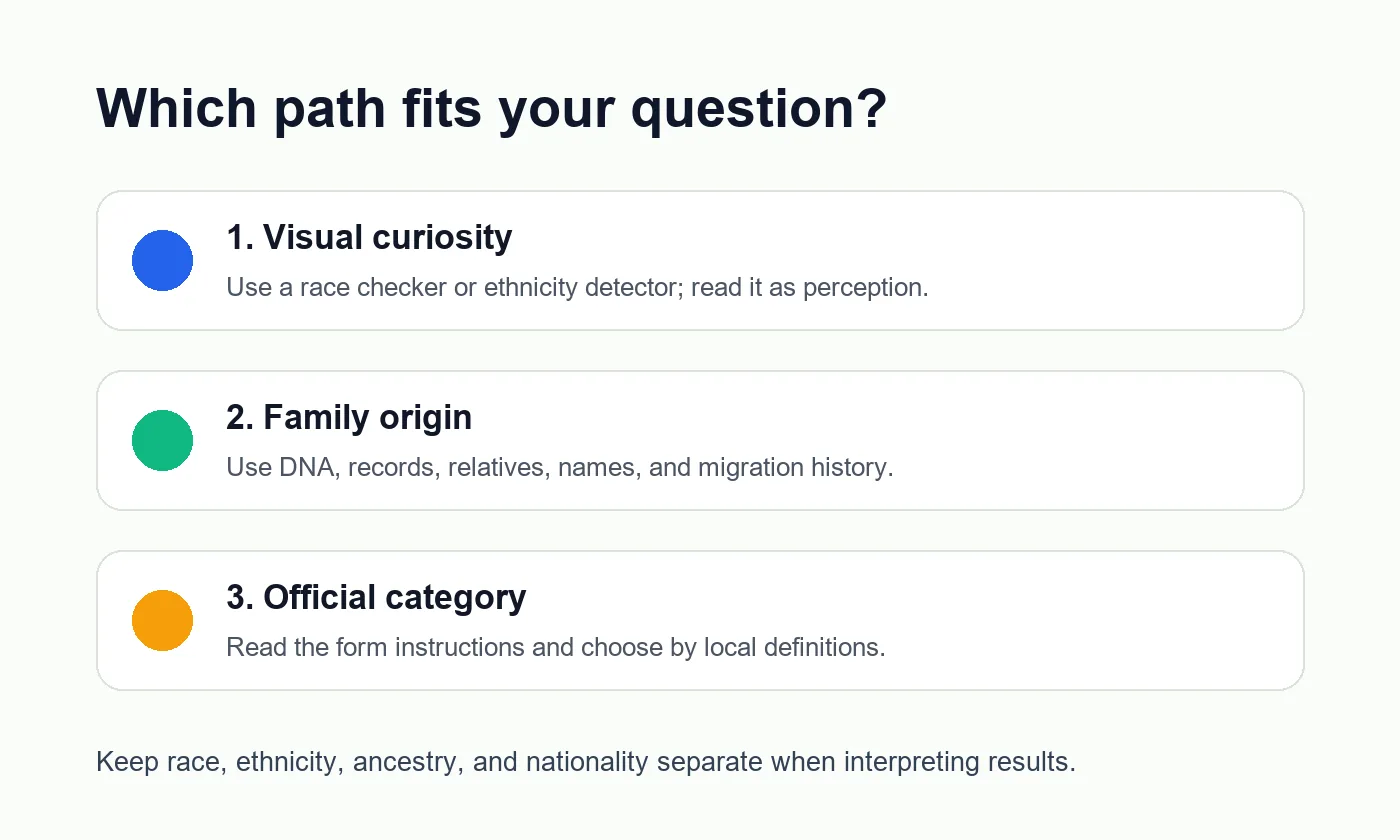
Start by clarifying your question first: appearance, ancestry, and official categories require different tools.
| Question | AI photo tool | DNA and records |
|---|---|---|
| What race do I look like? | Strong fit | Weak fit |
| What ancestry did I inherit? | Weak fit | Strong fit |
| Can this prove identity? | No | Partly, with context |
| How fast do I get an answer? | Seconds | Days to weeks |
Mixed, Ambiguous, and Edge-Case Results
This topic becomes confusing fastest in mixed-background cases. A mixed-race person may be read one way by strangers, identify another way socially, and have ancestry that is more complex than any single label. None of those facts automatically cancels the others.
The same applies to people asking whether white is a race or an ethnicity, whether Hispanic is a race, or whether American counts as an ethnicity. In most common usage, white is a race category, Hispanic is usually treated as an ethnicity, and American is a nationality. But official forms can vary by country and institution, so always read the local definition instead of assuming one system is universal.
- If you are mixed, you do not need to force one label unless a specific context requires it.
- If you are white, that does not tell you your ethnicity by itself.
- If you are Hispanic or Latino, your race may still be asked as a separate category on many forms.
- If you were born in the United States, your nationality is American, but your ethnicity may be Irish, Mexican, Filipino, Nigerian, or many other possibilities.
Privacy, Consent, and Official Categories
A lot of users really want help with forms, not philosophy. Schools, employers, hospitals, and government agencies often use broad category systems for reporting or compliance. Those categories are administrative shortcuts, and they may differ across countries.
That means the right answer can be context-specific. On one form, you may select more than one race. On another, ethnicity may be asked separately from race. If the form gives definitions, use those definitions first. If the form allows self-description, use the wording that best matches your lived identity and local context.
Best Next Step by Goal
Use this simple decision path if you are still unsure where to start.
You want a fast visual guess
Start with the AI ethnicity test or ethnicity detector. Treat the result as a photo-based estimate.
Best for quick curiosity and social-perception questions.
You want the family-history answer
Use a DNA kit, then compare the results with relatives, surnames, migration stories, and public records.
Best for ancestry and long-term research.
You want to understand the labels first
Read the ethnicity and born-in-America guides after this page to understand why race, ethnicity, and nationality should not be collapsed into one label.
Best for identity questions and FAQ-style confusion.
Use a Race Checker as a Starting Point, Not a Verdict
What race am I is a real question, but it is rarely a single question. Once you separate appearance, ancestry, ethnicity, and official categories, the confusion usually drops fast.
Use AI when you want a visual estimate. Use DNA and records when you want ancestry. Use local form definitions when the situation is administrative. And if your background is mixed, remember that a broad label may never capture the whole story by itself.
Frequently Asked Questions
About the Author
Sophie Laurent
Sophie Laurent writes about identity, ancestry, and the practical limits of AI and DNA tools. Her work helps readers separate appearance, family history, and social identity when they explore questions about race and ethnicity.