Ethnicity Estimate Guide: What DNA Ethnicity Results Really Mean
A practical guide to reading ancestry percentages, understanding why estimates change, and knowing when photo tools help or do not help

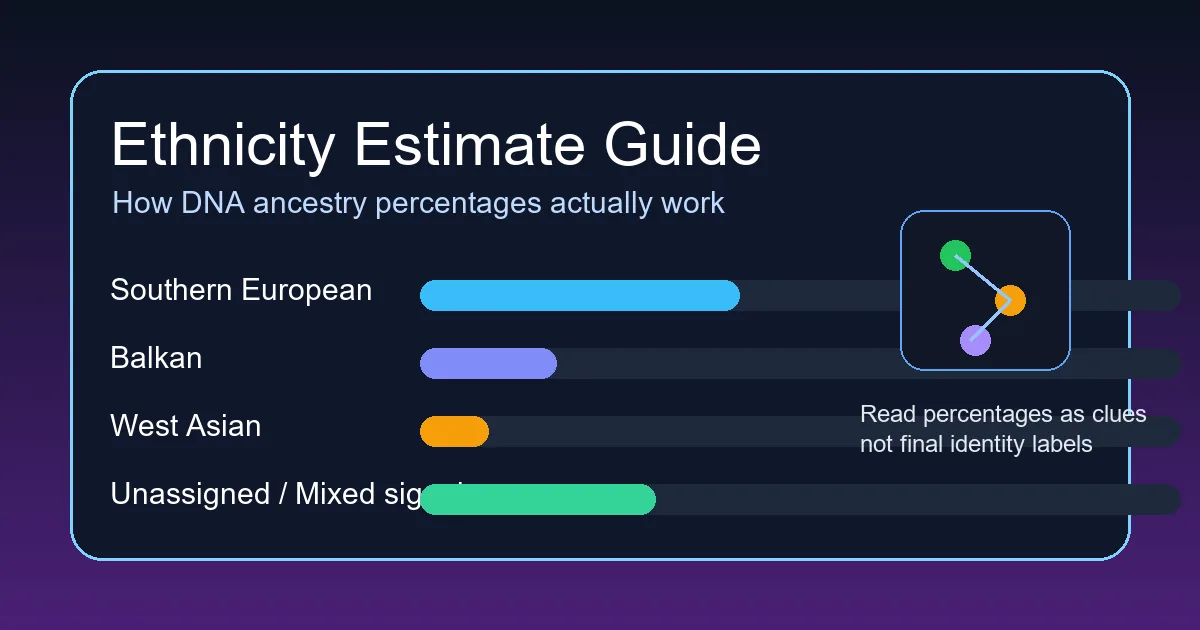
Table of Contents
If you have ever opened a DNA report and seen percentages like 42% Southern European, 18% Balkan, and 9% West Asian, the natural next question is what those numbers actually mean. Many people search for ethnicity estimate because they want a plain-language explanation before they trust a DNA kit, compare providers, or mix DNA results with photo-based ethnicity tools.
Quick Answer: An Ethnicity Estimate Is a Statistical Match, Not a Final Identity Label
An ethnicity estimate is a DNA company's best model of which reference populations your genetic markers resemble most closely. It is not a direct reading of nationality, citizenship, tribe membership, or the complete story of your family history.
The percentages are useful clues, especially at the regional level, but they depend on the provider's database, algorithm, and how many comparison samples they have for each population. That is why two companies can give different answers for the same person, and why your own result can change over time.
Key Takeaway
Use an ethnicity estimate as evidence to explore, not as the only proof of who you are.
What an Ethnicity Estimate Really Measures
Most DNA services compare parts of your genome against reference panels built from people whose families have lived in certain regions for multiple generations. The service is not reading culture, language, religion, or self-identification directly. It is matching inherited genetic patterns to a statistical population model.
This is why ethnicity estimate and ancestry are related but not identical. The estimate is one technical output inside a bigger ancestry story that also includes migration, recent family history, adoption, oral history, surnames, and historical records.
It also helps explain why nationality and ethnicity should not be mixed. A DNA estimate cannot tell you your legal nationality. It can only suggest which population groups your inherited DNA resembles.
How DNA Companies Build an Ethnicity Estimate
Different brands use different labels, but the workflow is usually similar.
1. Collect reference populations
A provider starts with sample groups tied to specific regions or communities. The quality of the estimate depends heavily on how large and well-defined those groups are.
2. Compare your markers
Your raw DNA data is compared against those reference panels to find the closest statistical matches across many parts of your genome.
3. Assign percentages
The model allocates percentages to the regions or populations that best explain the observed pattern. These percentages are estimates, not exact inherited fractions in a family-tree sense.
4. Update over time
When the provider expands its panel or changes its algorithm, your estimate can shift even if your DNA has not changed at all.
Do You Need DNA for an Ethnicity Estimate?
If your goal is a true ethnicity estimate in the genealogy sense, yes, you generally need DNA. A photo cannot reveal inherited markers, and an AI face tool cannot replace a genetic ancestry test.
If your goal is lighter curiosity such as what ethnicity you look like in a single image, then a photo-based tool can be useful for appearance-level exploration. That is a different question from inherited ancestry, and it should stay framed that way.
| Question | Best method | Why |
|---|---|---|
| I want inherited ancestry clues | DNA test | It compares genetic markers against reference populations. |
| I want to know what I look like in a photo | AI photo tool | It reads visible facial cues from one image. |
| I want the full family story | DNA plus records | Genetics alone cannot explain identity, migration, and culture. |
Why Ethnicity Estimate Results Change
People often worry when a report moves from one update to the next. In most cases, that change is normal.
- Reference panels improve. When a company adds more samples from underrepresented regions, your closest match can become more precise.
- Algorithms are rebalanced. A provider may decide that your DNA looks less like a broad region and more like a smaller neighboring cluster.
- Border regions are hard to separate. Adjacent populations often share centuries of overlap, so a percentage can move between labels without changing the core ancestry story.
- Small percentages are noisy. Very small components can appear, disappear, or merge after an update, especially below the strong-confidence range.
How to Read Ethnicity Percentages Without Overinterpreting Them
Start with the biggest components first. If several companies keep pointing you toward the same broad region, that is often more meaningful than a tiny single-provider percentage.
Then read the estimate next to the provider's confidence level, region notes, and any genetic communities or migration stories attached to the report. Those extra layers often matter more than the raw percentages alone.
Finally, test the estimate against offline evidence. Ask whether the result fits known grandparents, surnames, migration paths, oral history, and records. A good interpretation combines the DNA estimate with real-world context.
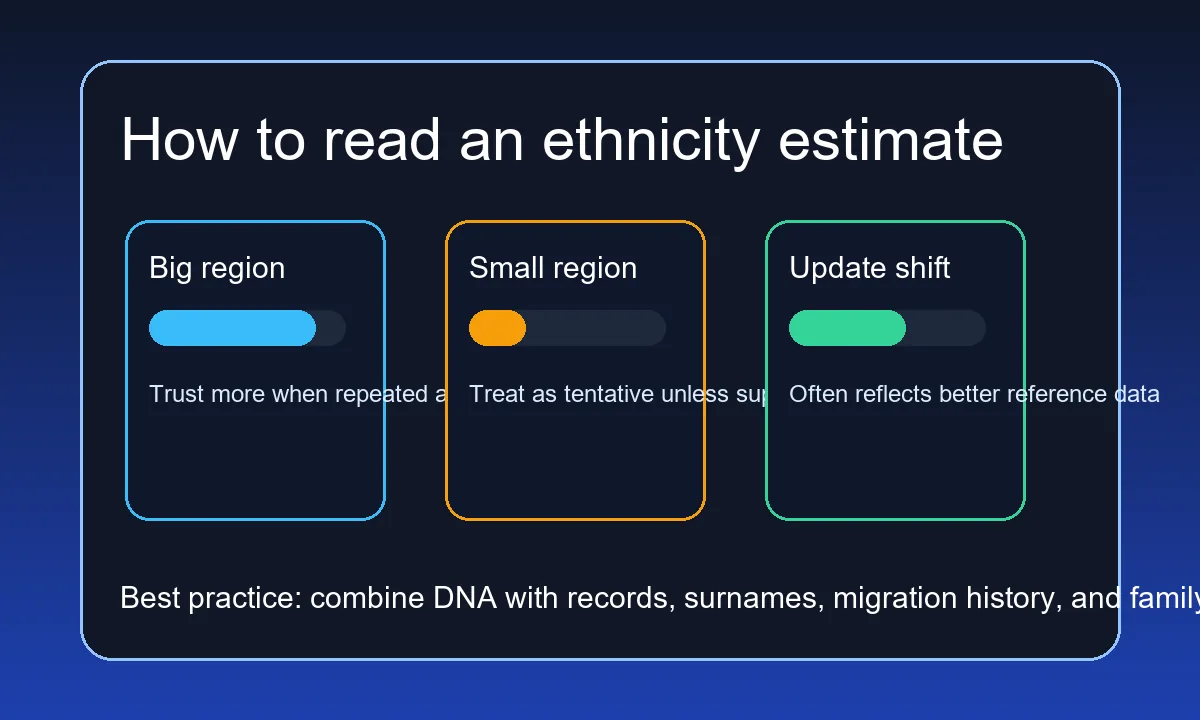
A simple way to read a DNA ethnicity estimate: treat percentages as probability-based clues, not final labels.
The Best Way to Know Your Ethnicity
No single source should carry the whole answer. The strongest approach combines different types of evidence.
Use DNA for inherited population clues
This is the most direct way to get an ethnicity estimate tied to ancestry rather than appearance.
Best for regional ancestry clues and identifying broad heritage patterns.
Use family records for names, dates, and places
Birth records, immigration documents, census data, and family interviews help confirm or refine what the estimate suggests.
Best for turning abstract percentages into real relatives and places.
Use AI photo tools only for appearance-based curiosity
They can answer what ethnicity do I look like, but they cannot replace DNA or documents.
Best for fast visual exploration, not proof of ancestry.
AI vs DNA: Which One Answers Your Question?
These tools are useful when they are matched to the right question.
| Question | AI photo tool | DNA test |
|---|---|---|
| What ethnicity do I look like? | Strong fit | Weak fit |
| What inherited ancestry regions might I have? | Weak fit | Strong fit |
| Can this prove my family history? | No | Partly, with records |
| How fast can I get an answer? | Seconds | Usually weeks |
Frequently Asked Questions
Use the Estimate, But Keep the Frame Honest
An ethnicity estimate can be genuinely useful when you treat it as a model built from reference populations rather than a perfect measurement of identity.
If you want a fast visual impression, use a photo tool. If you want inherited ancestry clues, use DNA. If you want the strongest answer, combine both with family history and records.
References
- National Human Genome Research Institute: genetic ancestry and human variation overview. View Source
- U.S. National Library of Medicine MedlinePlus: how genetic testing works. View Source
- International Society of Genetic Genealogy Wiki: ethnicity estimate background and limitations. View Source
About the Author
Sophie Laurent
Sophie Laurent writes about identity, ancestry, family history, and the practical limits of AI and DNA tools. Her work focuses on helping readers separate curiosity, evidence, and overclaiming when they explore where they come from.
Last updated: Updated May 31, 2026