Nationality vs Ethnicity: What Is the Difference?
A plain-English guide to nationality, ethnicity, race, ancestry, and citizenship, with examples for everyday conversations and official forms.

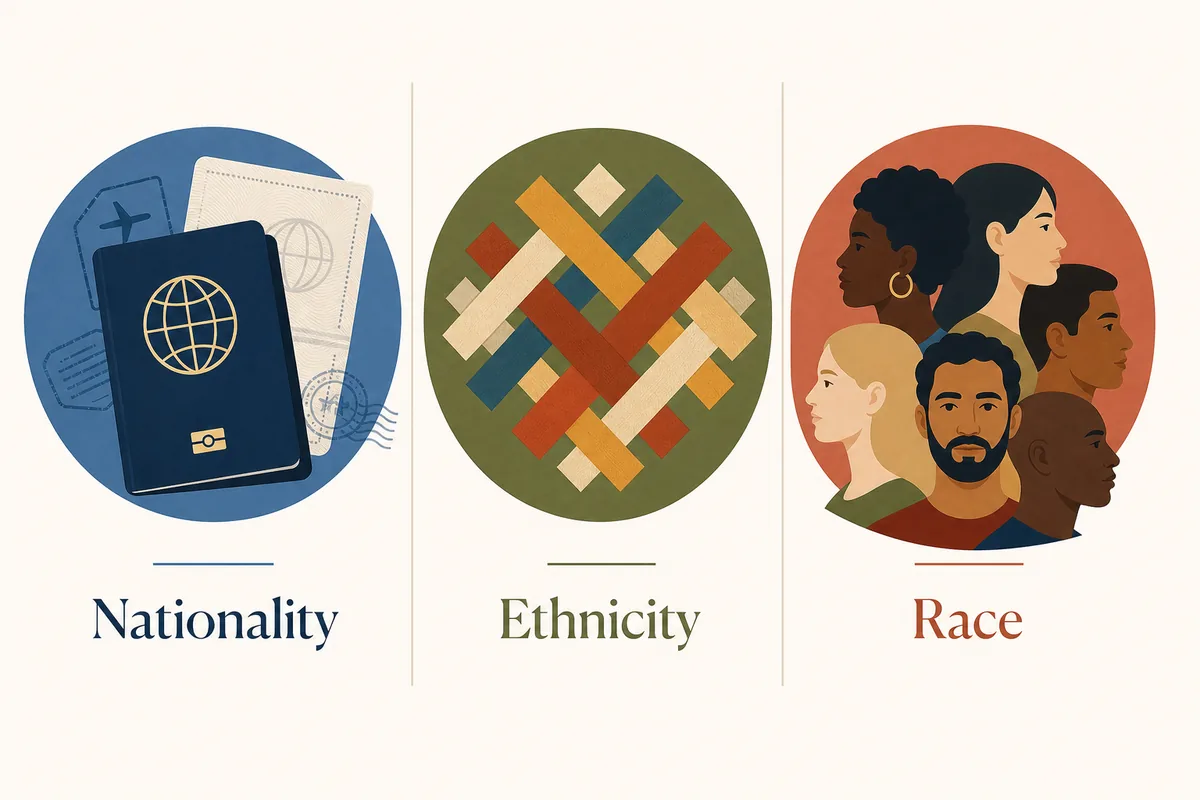
Table of Contents
Nationality and ethnicity are often used as if they mean the same thing, but they answer different questions. Nationality usually asks which country you belong to legally or politically. Ethnicity asks which cultural, ancestral, linguistic, or community background you identify with.
The confusion is understandable. A form may ask for nationality, another may ask for ethnicity, and a casual conversation may mix in race, ancestry, citizenship, heritage, and even how someone looks. This guide separates the labels so you can choose the right word without flattening your identity.
Nationality vs Ethnicity: The Quick Difference
Use nationality when the main question is about country membership, passport, citizenship, or national identity. Use ethnicity when the question is about cultural heritage, family background, language, traditions, or an ethnic community.
The two can overlap, but they do not have to. Someone can be Canadian by nationality and Punjabi by ethnicity. Someone can be Brazilian by nationality and Japanese, Yoruba, Italian, Indigenous, or mixed by ethnicity.
| Label | What it mainly describes | Example |
|---|---|---|
| Nationality | Country, passport, citizenship, or national belonging | Italian, Mexican, Japanese, American |
| Ethnicity | Shared culture, ancestry, language, traditions, or community | Kurdish, Han Chinese, Irish, Yoruba, Mexican American |
| Race | A broad social category often based on perceived physical traits | Black, White, Asian, Indigenous |
| Ancestry | Family lineage or genetic/geographic roots | One grandparent from Korea, two from Ireland, one from Nigeria |
Key takeaway
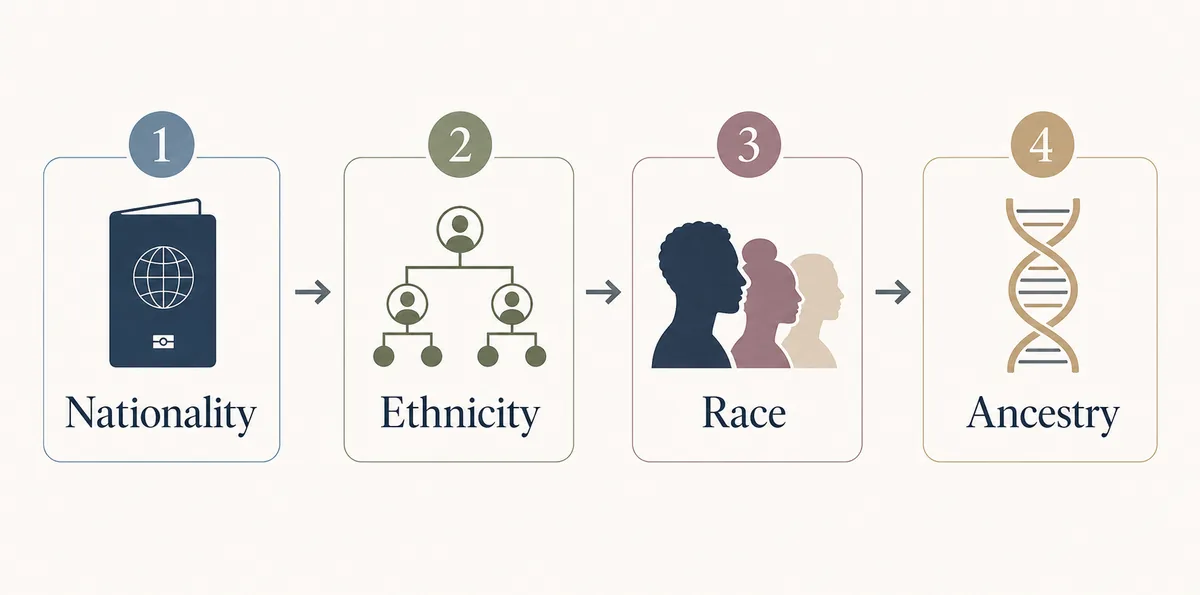
Nationality answers "which country?" Ethnicity answers "which cultural or ancestral community?" Race answers "which broad social category?" Ancestry answers "where do family lines trace back?"
What Each Identity Label Means
Nationality
Nationality usually refers to a relationship with a country. It can be legal, as in citizenship or passport status, or social, as in feeling part of a nation. In official contexts, nationality is often the most document-based label.
Examples include American, Indian, French, Nigerian, Brazilian, and Korean. A person can also have dual nationality if two countries legally recognize them.
Ethnicity
Ethnicity is more cultural and communal. It can include shared ancestry, language, religion, foodways, customs, history, and a sense of belonging. It is not limited to a current passport.
Examples include Basque, Arab, Tamil, Ashkenazi Jewish, Igbo, Han Chinese, Irish, Navajo, and many mixed or hyphenated identities. Ethnicity can also be self-described differently across generations.
Race
Race is a broad social classification that varies by country and time period. It is often connected to perceived appearance, skin tone, facial features, and historical categories, but it is not the same as ethnicity or nationality.
For example, Hispanic or Latino can be treated as ethnicity in some U.S. data contexts, while a Hispanic person may identify racially as White, Black, Indigenous, mixed, or another category.
Ancestry
Ancestry is about lineage: where your family lines, records, or DNA estimates trace back. It can support ethnic identity, but it does not automatically decide how you must identify culturally.
A DNA result may show regional ancestry while your lived ethnicity comes from language, family traditions, community ties, and self-identification.
How to Answer Forms That Ask for Nationality or Ethnicity
Start by reading what the form is trying to measure. Travel, immigration, and passport forms usually want nationality or citizenship. School, workplace, medical, or demographic forms may ask ethnicity, race, or ancestry for reporting and equity purposes.
If the form provides definitions, follow those definitions even if they are imperfect. If it allows a write-in answer, use the most specific accurate label you are comfortable sharing.
- Look for legal wording. Passport, citizenship, and country-of-citizenship questions usually mean nationality.
- Look for cultural wording. Heritage, community, language, or origin questions usually point to ethnicity.
- Do not force one label to do every job. You can answer nationality in one field and ethnicity or race in another field.
- Use mixed or multiple options when true. Many people have more than one ethnic background, and some forms allow multiple selections.
Examples: When Nationality and Ethnicity Are Different
The easiest way to understand the difference is to separate country membership from cultural heritage. The examples below are simplified, but they show why one label rarely tells the full story.
In conversation, you can choose the level of detail that fits the moment. On official forms, use the definitions and options provided by that specific institution.
| Situation | Nationality answer | Ethnicity or heritage answer |
|---|---|---|
| Born in Canada to Punjabi-speaking parents | Canadian | Punjabi, South Asian, or Indian heritage |
| Born in Brazil with Japanese family roots | Brazilian | Japanese Brazilian or Japanese ancestry |
| U.S. citizen with Mexican family background | American | Mexican American, Latino, or Hispanic depending on context |
| French passport holder from a Breton family | French | Breton and French cultural identity |
| Australian citizen with Lebanese grandparents | Australian | Lebanese Australian or Arab heritage |
Where AI Photo Tools Fit
AI photo tools can estimate how a face may be perceived across broad appearance patterns, but they cannot read a passport, legal nationality, lived culture, family language, or personal identity. Treat the result as an appearance-based clue, not as proof of ethnicity.
That distinction matters. An ethnicity detector may be useful if your question is "what ethnic background do I look like?" A nationality guesser can be fun for country-style guesses from a photo or name context, but nationality itself is not reliably visible in a face.
Try the right tool for the right question
Use the ethnicity detector for appearance-based ethnic resemblance, and use the nationality guesser only as a playful country-style estimate. For legal nationality, rely on official documents.
Nationality vs Ethnicity FAQ
Is American a nationality or ethnicity?
American is usually a nationality or national identity. It can describe citizenship or belonging to the United States. It does not automatically describe ethnicity, because Americans can have many ethnic backgrounds.
Can nationality and ethnicity be the same?
Yes, they can overlap when a national identity and an ethnic identity share the same name or cultural history. But they are still different concepts, and many people have a nationality that differs from their ethnicity.
Is Hispanic a race, ethnicity, or nationality?
Hispanic is generally treated as an ethnicity or cultural-linguistic label connected to Spanish-speaking heritage. It is not a nationality, and people who identify as Hispanic can belong to many race categories.
What should I put for ethnicity if I do not know?
Use the most accurate option available, such as unknown, prefer not to say, mixed, or a broader family-origin label. If the form is optional, you can leave it blank when you are not comfortable or do not know.
Can AI determine my nationality or ethnicity from my face?
AI can only estimate visible resemblance patterns from a photo. It cannot determine legal nationality, cultural upbringing, family history, language, religion, or self-identification.