Ethnicity Examples: How to Describe Heritage Clearly
A practical guide to ethnicity examples, mixed backgrounds, race vs ethnicity wording, and what to write on forms without flattening your identity.

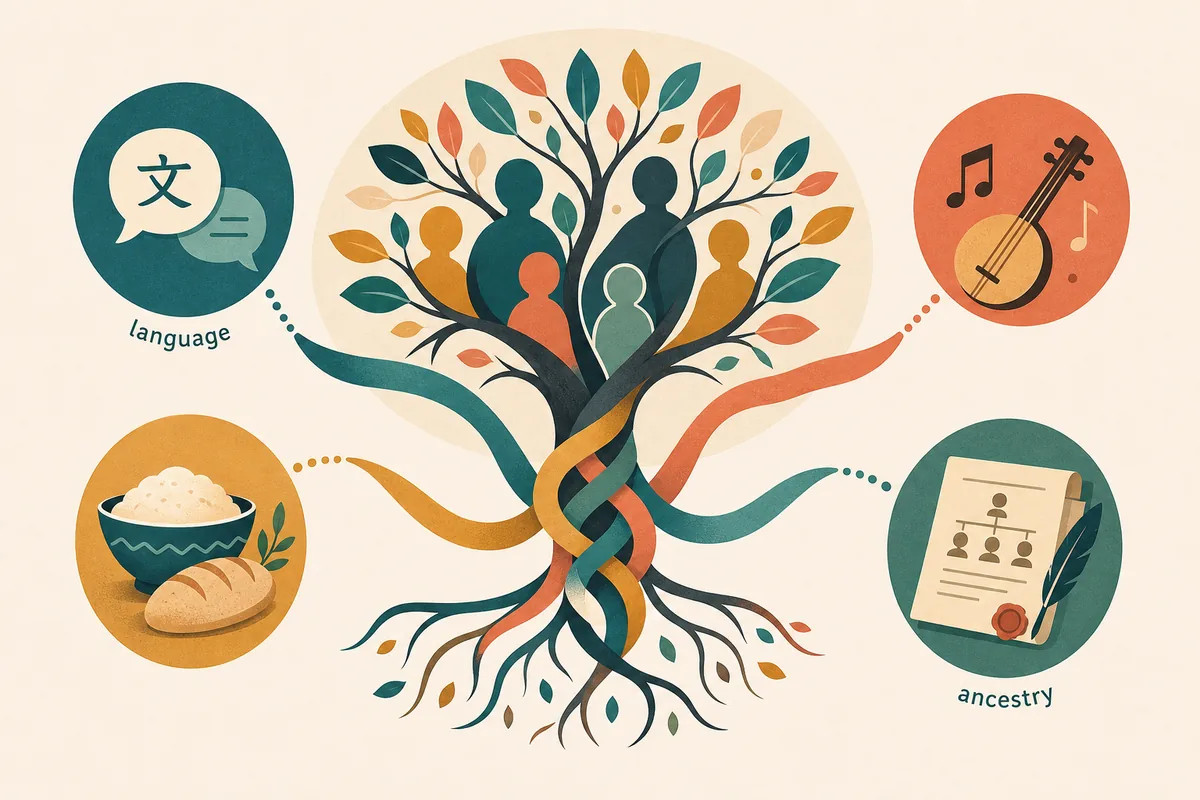
Table of Contents
When people search for ethnicity examples, they are usually not asking for a dictionary definition. They want wording that makes sense in real life: what to put on a form, how to describe a mixed family background, how ethnicity differs from race or nationality, and how to interpret an AI ethnicity estimate without treating it as proof.
This guide gives practical examples first, then explains the boundaries. Use the examples as language templates, not as rules about who someone must be. Ethnicity is usually self-described and context-dependent, so a person may choose a broad label in one setting and a more specific community label in another.
Quick Ethnicity Examples
Common ethnicity examples include Irish, Kurdish, Arab, Han Chinese, Punjabi, Yoruba, Tamil, Jewish, Mexican American, Navajo, Japanese Brazilian, Somali, Basque, and many mixed or hyphenated identities. Some labels describe a very specific ethnic community; others describe a broader regional or cultural family.
A useful ethnicity answer often combines ancestry and lived culture. For example, someone may say they are Korean American, Afro-Caribbean, Indigenous Australian, or Lebanese Canadian. Those answers can sit beside nationality and race answers rather than replacing them.
| Context | Example answer | Why it fits |
|---|---|---|
| Family heritage | Irish and Filipino | Describes family background from two cultural lines |
| Community identity | Yoruba | Names a specific ethnic and linguistic community |
| Broad regional label | South Asian | Works when the form or conversation needs a broader label |
| Hyphenated identity | Mexican American | Combines ethnic heritage with a national context |
| Indigenous identity | Navajo or Diné | Names a specific Indigenous nation/community |
Ethnicity Examples for Forms
Forms do not all use ethnicity in the same way. A school form may use broad demographic categories. A health survey may follow government categories. A job application may separate Hispanic or Latino ethnicity from race. A genealogy profile may invite a more detailed write-in answer.
The safest approach is to read the form's instructions first. If the form gives fixed categories, choose the closest accurate option or select multiple options when allowed. If it gives a write-in field, use a label that is true, specific enough, and comfortable for you to share.
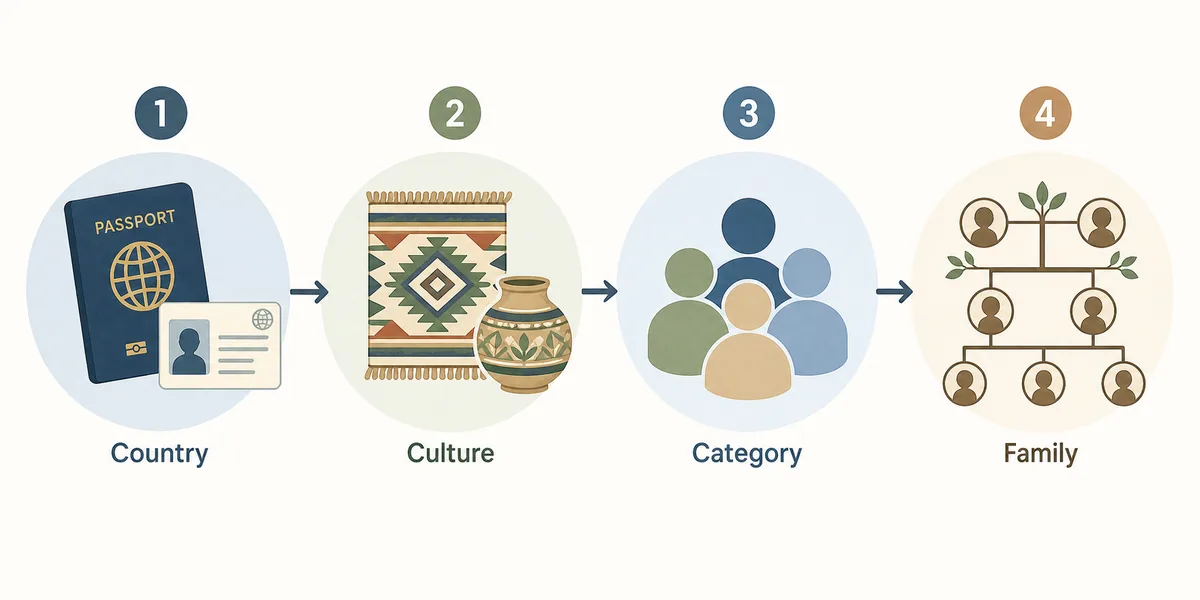
- Check whether the question asks country or citizenship. If it does, the form may be asking for nationality rather than ethnicity.
- Look for culture, origin, community, or heritage wording. Those clues usually point to ethnicity or ancestry.
- Use multiple selections when accurate. Mixed ethnicity is normal, and many forms now allow more than one response.
- Do not let a form erase nuance. A form category can be a reporting shortcut, while your personal identity can remain more detailed.
Mixed Ethnicity Examples
Mixed ethnicity means a person connects to more than one ethnic background, often through parents, grandparents, adoption, migration, marriage, or community life. It does not require equal percentages, a DNA test, or fluency in every family language.
When writing a mixed ethnicity answer, you can be specific when the setting allows it: Korean and Jamaican, Irish and Nigerian, Japanese Brazilian, Arab and Berber, or Mexican and Filipino. In a short form field, a broader answer such as mixed, multiracial, Hispanic and Asian, or two or more ethnicities may be the practical option.
| Situation | Possible wording | Best use |
|---|---|---|
| One parent Korean, one parent Jamaican | Korean Jamaican or Korean and Jamaican | Personal bio or open write-in field |
| Mexican heritage and U.S. upbringing | Mexican American | Everyday description or U.S. demographic context |
| Japanese family roots in Brazil | Japanese Brazilian | Nationality plus ethnic heritage context |
| Several backgrounds, no single dominant label | Mixed ethnicity or multiethnic | Short forms or broad demographic questions |
| Unknown family records | Unknown, mixed, or prefer not to say | Optional forms where accuracy matters |
Race vs Ethnicity Examples
Race and ethnicity can overlap in everyday conversation, but they are not the same. Race is usually a broad social category often connected to perceived physical traits and historical classifications. Ethnicity usually points to culture, ancestry, language, heritage, or community.
For example, a person may identify racially as Black and ethnically as Haitian, Afro-Latino, Yoruba, or Jamaican. Another person may identify racially as Asian and ethnically as Vietnamese, Punjabi, Han Chinese, or Korean American. The race label is broad; the ethnicity label adds cultural or ancestral detail.
Key takeaway
Use race for broad social categories and ethnicity for cultural or ancestral communities. If a form separates the two, answer each field according to the form's wording.
See the full nationality vs ethnicity guide for more examples.
Where AI Photo Tools Fit
AI photo tools can estimate how a face may be perceived across broad appearance patterns, but they cannot know your family history, language, cultural community, citizenship, or self-identification. Treat an AI estimate as a visual resemblance clue, not a final identity label.
If you are curious about appearance-based perception, an ethnicity detector can be useful for exploration. If you want to know your actual ethnicity, combine family records, conversations, cultural context, DNA or ancestry research when appropriate, and your own self-identification.
Use the right tool for the right question
Use the detector for appearance-based resemblance, then read the guide if your real question is about family background and identity.
Ethnicity Examples FAQ
What are 5 examples of ethnicity?
Five examples are Irish, Han Chinese, Yoruba, Tamil, and Mexican American. The exact answer depends on whether you need a specific community, a broad regional label, or a form category.
Is American an ethnicity?
American is usually a nationality or national identity. Some people use it culturally, but it does not automatically describe ethnicity because Americans can have many ethnic backgrounds.
Is Hispanic a race or ethnicity?
In many U.S. contexts, Hispanic or Latino is treated as an ethnicity, not a race. A Hispanic person may identify racially as White, Black, Indigenous, mixed, or another category.
Can I have more than one ethnicity?
Yes. Mixed or multiethnic backgrounds are common, and many forms allow more than one selection or a write-in answer.
Can AI tell my ethnicity from a photo?
AI can estimate visible resemblance patterns, but it cannot determine lived ethnicity, nationality, family history, culture, or self-identification.