Race vs Ethnicity: What Is the Difference? Examples and Forms
Race and ethnicity can overlap, but they describe different parts of identity. Here is a practical way to separate them without oversimplifying people.


In this guide
People often use race and ethnicity as if they were interchangeable. They are not. The confusion is understandable because both terms appear on school, medical, employment, research, and government forms, and because institutional categories have changed over time.
The most useful distinction is not that one term is biological and the other is cultural. Modern research treats racial categories primarily as social and historical classifications, not precise genetic divisions. Ethnicity is also social, but it focuses more directly on cultural belonging, shared origin stories, language, customs, and community ties.
These labels can matter because they shape lived experience, discrimination, community support, public policy, and how people describe themselves. At the same time, no checklist can capture every family history or mixed identity. The person’s own description should remain central.
Race vs ethnicity at a glance
The table below gives a practical comparison. It is a guide, not a rule for judging another person’s identity.
Appearance is not a reliable method for determining ethnicity. People who look similar can have different languages, histories, and communities; people in the same ethnic group can look very different.
| Concept | Main focus | Common examples | Can be multiple? |
|---|---|---|---|
| Race | Broad social categories shaped by history and perceived traits | Black, White, Asian, Indigenous, Middle Eastern or North African in some data systems | Yes |
| Ethnicity | Shared culture, ancestry, language, traditions, or community | Latino, Han Chinese, Punjabi, Kurdish, Yoruba, Jewish, Māori | Yes |
| Nationality | Citizenship or formal connection to a country | American, Brazilian, Japanese, Nigerian | Yes, depending on citizenship laws |
Key takeaway
Race and ethnicity are not synonyms. Race usually describes a broad social classification; ethnicity describes cultural or ancestral belonging. Nationality answers a different question about country and citizenship.
Definitions that do not blur together
What race means
Race is a system societies use to group people. The categories are broad, vary by place and period, and often depend on how institutions or other people perceive someone. The same person may be classified differently in different countries.
Racial categories can still have real consequences even when they are not precise biological divisions. They can influence exposure to discrimination, neighborhood conditions, health care, education, and political representation. Saying race is socially constructed does not mean racism or racial inequality is imaginary.
What ethnicity means
Ethnicity describes belonging connected to culture and shared heritage. Language, religion, migration history, regional origin, food, music, customs, and family traditions may contribute, but no single feature is required.
Ethnic identity can be inherited, practiced, rediscovered, or changed in emphasis. Someone may identify with several ethnic communities, especially in mixed families or diasporas. Others may prefer a regional, tribal, national, or religious identity instead of a broad ethnic label.
Why the boundary is sometimes fuzzy
Institutions do not use these words consistently. A label may function as an ethnicity in one country and as a race, nationality, or language group elsewhere. Hispanic or Latino, for example, has historically been treated as an ethnicity in U.S. federal data even though people within that group may identify with many races.
The safest approach is to state what a form or study means by each category, allow multiple selections when possible, and include a write-in option. In conversation, ask how a person identifies rather than guessing from a name, accent, or photo.
Race and ethnicity examples in everyday life
Examples work best when they show that the categories answer different questions. They should not be used to assign an identity to someone else.
A person can be racially Asian, ethnically Korean, and nationally Canadian. Another person can identify as Black, ethnically Yoruba and Caribbean, and nationally British. A Latino person may identify as White, Black, Indigenous, multiracial, or another race.
| Example | Race | Ethnicity | Nationality |
|---|---|---|---|
| Korean Canadian | Asian | Korean | Canadian |
| Afro-Brazilian | Black | Afro-Brazilian | Brazilian |
| Mexican American with Indigenous heritage | Indigenous and/or another self-selected race | Mexican; specific Indigenous community if applicable | American and/or Mexican |
| Mixed family background | One or more self-selected races | Two or more ethnic heritages | One or more nationalities |
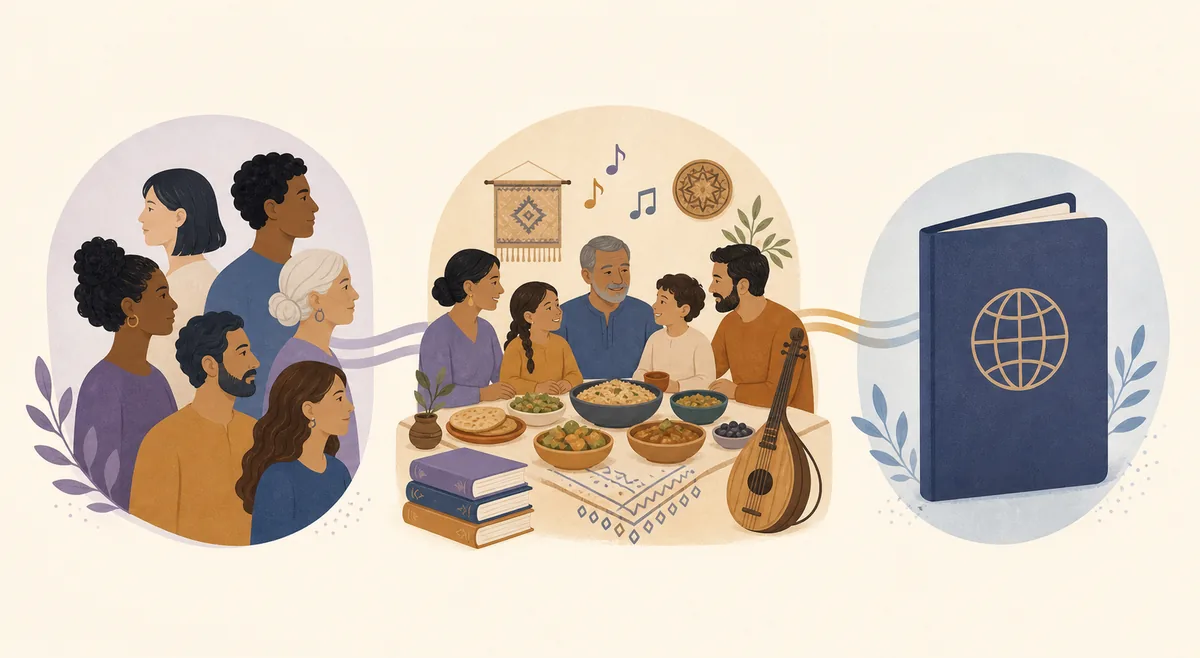
Race vs ethnicity vs nationality
Nationality is the easiest of the three to separate conceptually because it usually refers to citizenship, legal status, or a formal relationship with a state. It does not automatically reveal race or ethnicity.
An American, French, South African, or Singaporean nationality can include people from many racial and ethnic backgrounds. Likewise, one ethnic group may live across several countries, and a person may hold dual nationality.
When a question really asks where someone was born, use birthplace. When it asks citizenship, use nationality or citizenship. When it asks cultural heritage, use ethnicity. When it asks about broad social classification and unequal treatment, race may be relevant.
- Birthplace is an event, not an ethnicity.
- Nationality can change through naturalization; ethnicity usually does not change in the same legal way.
- Race and ethnicity may be self-identified, externally assigned, or recorded differently across systems.
- No category permits reliable conclusions about personality, intelligence, behavior, or ability.
How should you answer race and ethnicity on a form?
First read the form’s instructions. A census, hospital intake form, school application, and private survey may define categories differently. If the form allows multiple answers, select every category that accurately reflects how you identify.
Use a write-in field to add a specific community when the broad choices feel incomplete. For a child, families may list multiple backgrounds rather than choosing one side. If you are completing data for another adult, ask them instead of inferring.
When a form forces a choice that does not fit, select the closest accurate option only if necessary and use an optional explanation field. For important medical, legal, or benefits forms, ask the organization how the information is used and whether self-description can be corrected.
- Check whether the question asks race, ethnicity, ancestry, nationality, birthplace, or citizenship.
- Follow the form’s definitions rather than assuming every institution uses the same categories.
- Choose multiple options when permitted and appropriate.
- Use a write-in field for a more specific identity.
- Do not guess another person’s category from appearance or surname.
What changed in current U.S. race and ethnicity standards?
In March 2024, the U.S. Office of Management and Budget revised Statistical Policy Directive No. 15, the federal standards used for collecting and presenting race and ethnicity data. A major change is a combined race-and-ethnicity question that allows respondents to select one or more categories in the same question.
The revision also added Middle Eastern or North African as a minimum reporting category and emphasized detailed write-in responses. Federal agencies are implementing the standards through their own programs and schedules, so forms may not all look identical at the same time.
These are data standards, not a final definition of personal identity. They are designed to improve consistency and representation. Individuals may use more specific community names in daily life than a government form can display.
Is ethnicity the same as ancestry or a DNA estimate?
Ancestry describes family descent and geographic lineage. It can contribute to ethnicity, but ethnicity also includes culture, community, and self-identification. A person can have ancestry from a region without actively belonging to every culture associated with that region.
Consumer DNA ethnicity estimates compare selected genetic markers with reference panels. The percentages are statistical estimates, can change when databases or models are updated, and do not prove race, nationality, tribal citizenship, or cultural membership.
Family records, community knowledge, oral history, historical documents, and DNA evidence can each answer different questions. Treat them as pieces of a broader story rather than a single identity score.
Important limitation
Neither a face-analysis tool nor a DNA percentage can define someone’s race or ethnicity with certainty. Use such tools for curiosity, not for medical, legal, employment, immigration, or eligibility decisions.
How to use race and ethnicity respectfully
Use the most specific term that is relevant and that the person or community accepts. Do not mention race or ethnicity when it has no bearing on the subject. When writing about inequality, be precise about whether the issue involves self-identity, discrimination, geography, migration, language, or institutional categories.
Capitalization and preferred labels vary by style guide and community. If you are collecting data, explain why, allow self-identification, minimize mandatory fields, protect privacy, and avoid turning broad categories into stereotypes.
- Ask, do not assume.
- Allow more than one identity when possible.
- Separate race, ethnicity, nationality, ancestry, and religion.
- Avoid using appearance as evidence of culture.
- Use category data to understand patterns, not to predict an individual.
Frequently asked questions
Authoritative references
- 2024 OMB Statistical Policy Directive No. 15 — Official federal standards for race and ethnicity data.
- U.S. Census Bureau: Race and Ethnicity — Research and explanations about how the Census Bureau measures identity.
- National Human Genome Research Institute — Background on genetics, genomics, and why social identity labels are not genetic test results.
Continue exploring identity terms
- Nationality vs ethnicity — Separate citizenship from cultural heritage.
- Ethnicity examples — See specific examples without treating identity as a checklist.
- What race am I? — Understand self-identification and form categories.
- What ethnicity am I? — Explore family history, culture, and community responsibly.
- What does biracial mean? — Compare biracial, multiracial, mixed-race, and multiethnic identity.